

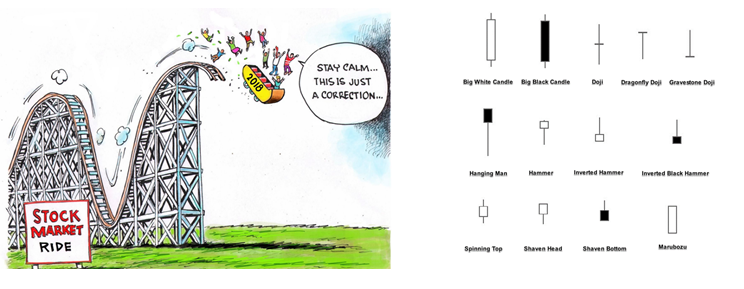
Future market forecasting techniques may be classified into two major categories: (1) fundamental analysis and (2) technical analysis. Fundamental analysis is based on macro-economic data such as Purchasing Power Parity (PPP), Gross Domestic Product (GDP), Balance of Payments (BOP), Purchasing Manager Index (PMI), Central Bank outcomes, etc. On the other hand, technical analysis focuses on past data and potential repeated patterns within those data. The major point here is that history tends to repeat itself. As opposed to fundamental analysis, technical analysis makes short term predictions such as weekly, daily, or even hourly predictions.
At the end of the 20th century technical analysis of financial markets as a method to forecast and predict future prices has been subject to great criticism when comparing it to the method of fundamental analysis [1]. Nonetheless, in the following years, a substantial amount of evidence has been shown to support the claim that technical analysis can give us insight into upcoming trends of the market and to accurately determine the moment in which the trend changes [2].
As the field of machine learning and deep neural networks developed, the methods of text analysis have been proven to be more and more reliable. Thus, although combining technical analysis with advanced machine learning algorithms has been researched [3] [4], the task of predicting financial markets via machine learning has been mainly performed with fundamental analysis tools.
In this project, there has been an attempt to predict, with algorithms of machine learning and in the inspiration of technical analysis, future prices of stocks from the NSDQ in the resolution of days.