

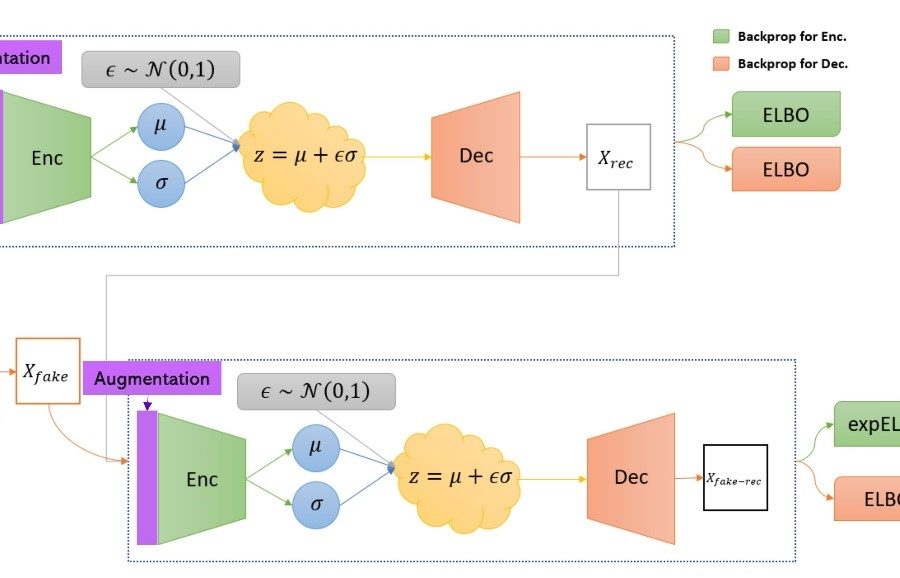
The recently introduced Soft Introspective Variational Auto-Encoder (Soft-IntroVAE) is an explicit deep generative model that enjoys the good traits of variational auto-encoders (VAEs) and generative adversarial networks (GANs) by proposing a variational-based approach to adversarial training, and it exhibits outstanding performance in various tasks such as density estimation, image generation and more. However, in adversarial training, it is quite common that the discriminatory module (discriminator in GANs, encoder in Soft-IntroVAE) may overfit at some point to the training data, preventing further improvements for the generative module (generator in GANs, decoder in Soft-IntroVAE). In this project, we researched and implemented different data augmentations and regularization methods with the aim of improving the Soft-Intro VAE model in terms of generation quality on the CIFAR-10 dataset. We achieved our best results using differentiable augmentations on both real and fake data which also act as a regularization and managed to improve the FID score from 4.30 to 2.96 on the CIFAR-10 dataset, further narrowing the gap between VAE based models and GANs. This work contains a detailed analysis of our method’s theoretical and empirical justification as well as of the exact source of our significant improvement. In addition, we present results on downstream tasks our model can be useful for as a consequence of being trained with augmented data.