

Amputation of limbs, specifically of hands, may be caused by a workplace accident, a traffic accident, a combat injury, or may even be congenital. There are different solutions which provide the possibility for amputees to lead as much of a normal life as possible. Many of these solutions are expensive, heavy, and cumbersome for everyday use. Among those, there exist solutions for moving a prosthetic arm via different muscles, including those of the amputated arm, which is not preferred by those suffering from phantom pain. Our project aims to provide a system which will not suffer from these disadvantages.
In the past a Masters’ student at the Technion developed a lightweight and cheap robotic prosthetic arm. This project was done with the organization “Haifa3D”, which provides this arm free of charge and custom made for every amputee which requests it.
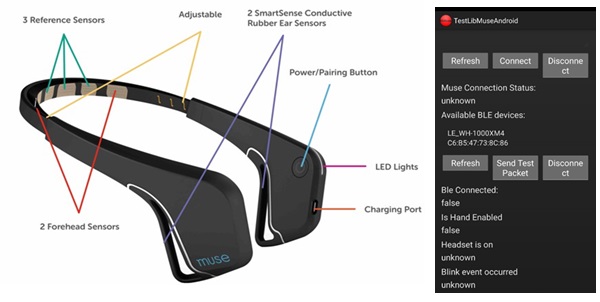
This project was also made with cooperation from “Haifa3D”, and its goal is to control the robotic hand via the signals detected by a brain wave sensor called “MUSE”. The sensor has several types of signals which can be extracted from it, where in this project we utilized its ability to detect blinks and jaw clenches, from which we constructed triggers which control the hand’s motions. This project included the development from scratch of an Android application, which connects both to the MUSE and the hand, facilitating the communication between them, and performing the necessary signal processing for the extraction of the triggers.