

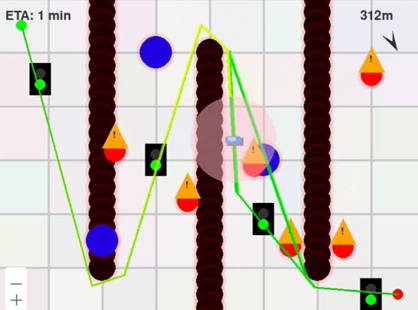
In recent years, autonomous navigation systems have become increasingly sophisticated, with applications ranging from self-driving cars to delivery robots. These systems face numerous challenges, particularly in dynamic environments where conditions change rapidly and unpredictably. While traditional pathfinding algorithms excel in static environments, they often struggle when confronted with moving obstacles, traffic signals, and the need for real-time path adjustments.
Our project implements an intelligent pathfinding system inspired by modern navigation applications like Waze. The system combines Rapidly exploring Random Trees (RRT) with real-time obstacle avoidance and traffic management, creating a robust solution that can adapt to changing conditions while maintaining optimal path efficiency.
The primary challenge lies in achieving a balance between path optimization and safety (obstacle avoidance) requirements. Our approach focuses on creating a system that can not only plan efficient routes but also adjust them in real-time while maintaining safety parameters. We developed a solution that integrates several key components: an RRT-based path planner for initial routes, a continuous path optimization system, dynamic obstacle management for monitoring and predicting collisions, and traffic management for handling traffic light states.
The system demonstrates significant advantages over traditional approaches, successfully navigating through environments with multiple moving obstacles while maintaining optimal path lengths and ensuring safety. It provides real-time path adjustments without significant computational delay, making it suitable for real-world applications. The implementation proves particularly effective in scenarios where traditional static pathfinding algorithms would fail, demonstrating its potential for various autonomous navigation applications.
Future development could enhance the system’s capabilities through advanced sensors integration for improved obstacle prediction, multi-agent coordination, and advanced traffic pattern recognition. The current implementation provides a solid foundation for further advancement in autonomous navigation systems, particularly in dynamic urban environments.