

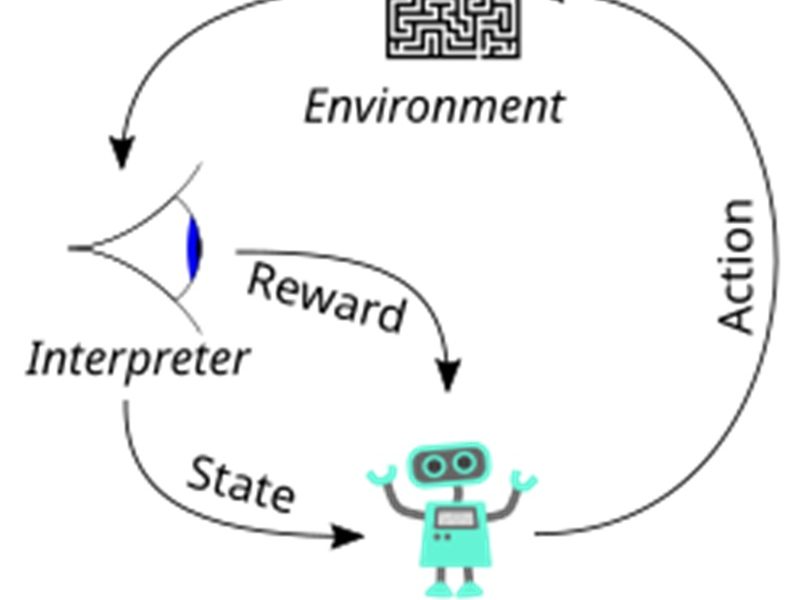
our project focuses on developing a reinforcement learning-based stock trading environment using PyRDDLGym and Proximal Policy Optimization (PPO) agent. The aim is to simulate a financial market where intelligent agents learn optimal trading strategies through interaction with a dynamic environment. This approach leverages Markov Decision Processes (MDPs) and Partially Observable Markov Decision Processes (POMDPs) to model the complexities of real-world stock trading, including price fluctuations, transaction costs, and market volatility.
PyRDDLGym provides a structured framework for defining the environment, where state variables, actions, rewards, and transition dynamics are explicitly modeled. The state variables can include historical stock prices, technical indicators, and market sentiment, while the actions represent buy, sell, or hold decisions. The reward function is carefully designed to encourage profitable trading while managing risk.
To train the trading agents, the project implements Proximal Policy Optimization (PPO), a policy-based reinforcement learning algorithm that efficiently balances exploration and exploitation. PPO updates policies in a way that prevents large fluctuations, ensuring stability in learning. The agent is trained using historical market data or a simulated stock environment, where it continuously refines its decision-making ability by maximizing long-term rewards.
The project involves multiple stages, including data preprocessing, environment modeling, agent training, hyperparameter tuning, and performance evaluation. The effectiveness of the trained agent is measured using key financial metrics such as cumulative returns, the Sharpe ratio, and maximum drawdown. Comparative analysis with traditional trading strategies and other reinforcement learning techniques can further validate its performance.
By successfully implementing this system, the project contributes to the advancement of algorithmic trading and showcases how reinforcement learning can be used to create autonomous agents capable of making real-time trading decisions. The findings could be beneficial for applications in quantitative finance, hedge fund strategies, and portfolio management, paving the way for more intelligent, data-driven financial decision-making systems.