

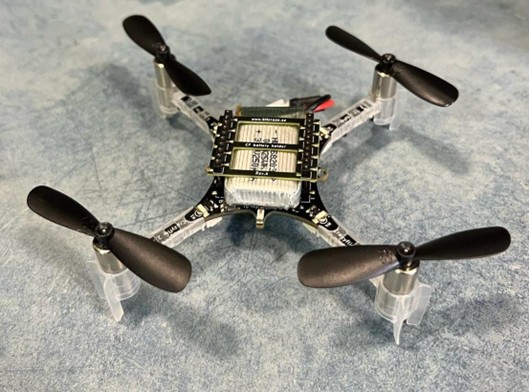
In recent years, drone uses in both civilian and militaristic contexts have increased exponentially. This has increased the need for effective detection and tracking measures, especially in defense and security. Most detection systems in use today usually rely on radio-frequency (RF) radar or laser-based LiDAR technologies. These systems, however, struggle to detect small drones as their size makes them almost invisible to most radars.
An alternative solution is acoustic monitoring- using the sound produced by drones to detect them. Current techniques in this field tend to use microphone arrays to obtain spatial information. However, to emulate hardware constraints, our setup only had a single microphone, making traditional localization approaches difficult. Instead of attempting to locate the drone directly, we attempted to classify its type of movement (hovering, ascending, descending, moving towards and away from the microphone, and turning), as these can indirectly indicate the location of the drone relative to the microphone.
To achieve this, we constructed a dataset containing audio recordings of a drone flying along a predetermined path, accompanied by position logs that track the drone’s movements. We then explored various methods for extracting features from the audio signal and compared the classification performance of several classification models.
Our conclusion is that even with hardware constraints such as a single microphone, it is possible to extract meaningful information about a drone’s motion from its acoustic signal using the methods we developed.