

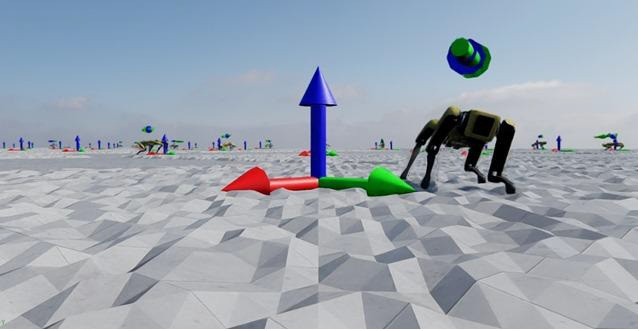
This project focused on training the SPOT quadruped robot in NVIDIA’s Isaac Lab simulation environment, aiming to develop walking capabilities at different speeds and later extend them to goal-directed navigation. The main challenge was to enable the robot to learn stable and flexible locomotion control under conditions that realistically simulate the physical world.
To address this, we applied Reinforcement Learning (RL) methods, using the RSL-RL library for policy training and Isaac Lab’s interfaces for generating states, observations, and commands. The training process concentrated on both velocity control and goal-oriented navigation.
The results demonstrate that it is possible to achieve reliable control across varying speeds and to successfully guide the robot toward a defined goal, including traversing a virtual maze. We conclude that reinforcement learning in advanced simulation environments is an effective tool for developing complex robotic behaviors, although challenges remain such as long training times and sensitivity to environment configuration.
Screenshot captured