

Proof of Work cryptocurrencies like Bitcoin and Ethereum implement digital currencies. Such
cryptocurrencies are based on decentralized blockchain protocols, relying on incentives for their
security. Blockchains are maintained by miners who use computational power to create new
blocks. In return, the protocols distribute rewards to their miners in the form of virtual tokens.
Ideally, every miner should get her fair share of the reward, based on how much computational
power she controls. However, many protocols are vulnerable to a behavior called selfish mining ,
where a miner deviates from the desired behavior to obtain more than her fair share. Such
deviations destabilize the protocol, harming its safety and liveness guarantees. The security
threshold of a blockchain protocol is the minimum relative computational power required to
perform selfish mining. The threshold should be high enough such that no miner is motivated to
deviate.
In previous project, the system was the modeled as MDP, with the assumption that all blocks
have the same value, and there are no transactions in the blockchain, however, blockchain
usually includes transactions, where a block either includes a transaction or not, and the value of
each block calculated accordingly.
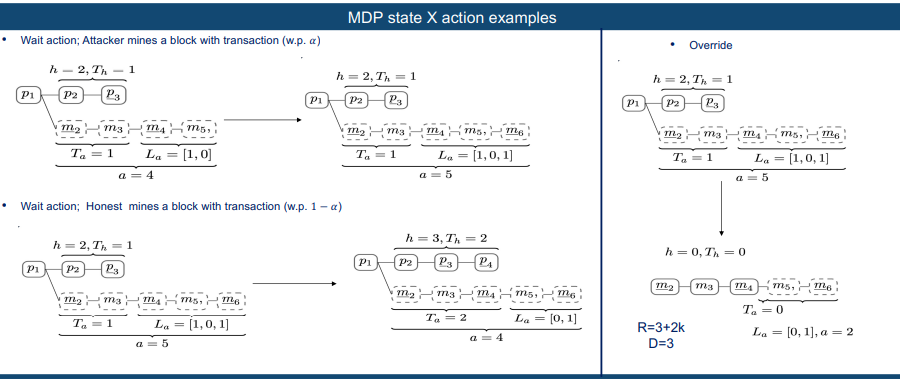
In thus project, we enhanced the MDP, adding the consider of the transactions in the network, as
well as the revenue function.
We found out that considering the transactions affects the security threshold, and the power
needed for selfish mining affected hardly by the value of each transaction; blockchains with high
values of transactions will be more likely to have selfish miners