

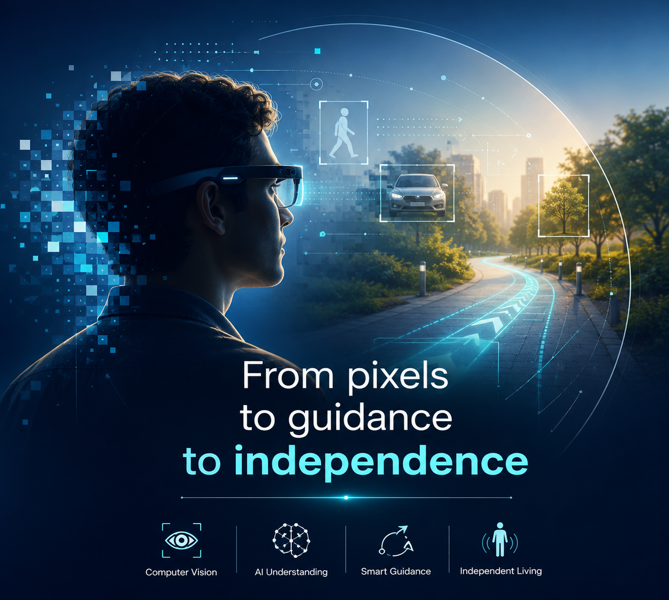
This project presents the design, implementation, and verification of a modular real-time computer vision application for Project Aria smart glasses, with an emphasis on assistive wearable technology for blind and visually impaired users.
The developed system connects to Project Aria glasses through the official Aria Client SDK, receives a live video stream, processes the frames on a host computer using an Ultralytics YOLO object detection model, and displays the processed stream through graphical interface. The system was designed as a robust software infrastructure. It separates the delicate Project Aria connection flow from the computer vision pipeline, voice feedback, hand guidance, video recording, and environment diagnostics.
A central motivation of the project is to create a technological foundation for assisting blind and visually impaired people in understanding their surroundings. By detecting objects in real time and providing spoken feedback, the system can help the user identify objects in the environment, locate target items, understand where they are positioned in the camera view, and receive guidance toward them. In future extensions, the same infrastructure can also support spatial navigation, obstacle awareness, and warnings about potential hazards or dangerous objects in the user’s path.
The project supports two main usage modes: a basic mode intended for first-time demonstrations, and an advanced mode that exposes full configuration control. The system can optionally provide spoken feedback through the computer speakers, guide the user’s hand toward a detected target object, save snapshots, export detection metadata to JSON and CSV, record local annotated video clips, and run installation and environment diagnostic command before connecting to the glasses.
The project combines wearable sensing, real-time video streaming, computer vision, object detection, assistive feedback, and robust software design. The system was built to handle common technical problems in a clear way. For example, if required packages are missing, if an audio backend is not available, if MediaPipe is not installed, if OpenCV cannot save video, or if the Project Aria SDK is missing, the program provides informative error messages and diagnostic .
Overall, the system provides a useful foundation for work with Project Aria, especially for applications such as real-time object detection, object finding, basic spatial guidance, obstacle awareness, and assistive tools for blind and visually impaired users.