

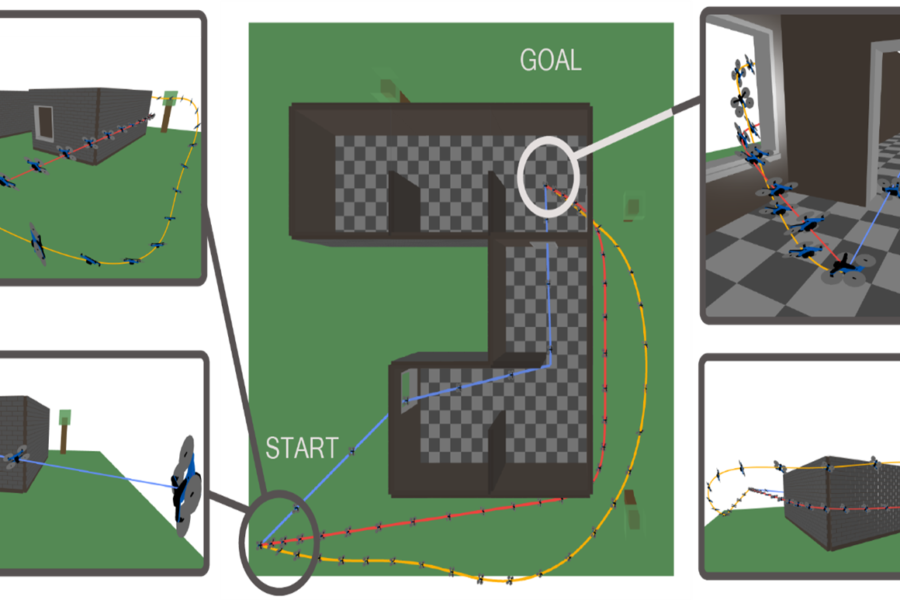
This project addresses autonomous quadrotor navigation in complex 3D environments by generating smooth and collision-free trajectories in simulation. We construct dense obstacle maps and decompose the free space into convex safe regions. Using the Graph of Convex Sets (GCS) framework, we formulate motion planning as a shortest-path optimization problem through these regions while enforcing velocity, acceleration, and high-order continuity constraints up to the fourth derivative (snap). This ensures that the resulting trajectories are smooth and dynamically reasonable.
After computing the geometric path, we apply quadrotor differential flatness to reconstruct the full dynamic states of the UAV, including position, velocity, orientation, and rotor thrust commands, ensuring physical feasibility. To generate diverse data, the environment is divided into 5m × 5m grid cells, and multiple randomized start–goal pairs are sampled across the map. Trajectories are sampled at 100 Hz and stored as time-aligned states, actions, and control inputs. Additionally, we compute the minimum obstacle distance (ESDF) as a safety feature to help future learning models understand clearance from obstacles. The final outcome is a large, structured dataset designed to support learning-based autonomous drone navigation.