

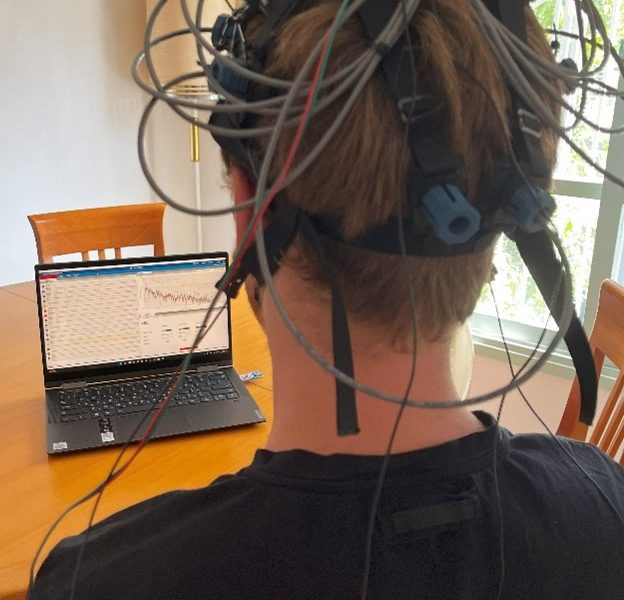
ALS (Amyotrophic lateral sclerosis) is an Incurable disease that results in the progressive loss of motor neurons that control voluntary muscles up to complete paralysis. In progressive stages of the disease, patients struggle to communicate with their environment. One attempt at solving this problem is using a brain-computer interface.
The goal of our project is to use machine learning to bridge the gap between the resources available to the general population, in terms of cost etc., and the desired brain-computer interface functionality.
A major problem in brain-computer interfaces relates to the non-stationarity of brain signals, meaning that the data’s behavior changes over time. Consequently, the performance of a classifier, even when trained on recent data, can deteriorate quickly over time.
In part A of the project, we focused on extracting features that are specifically designed to handle this kind of problem – non-stationary physiological signals. In part B of the project, we focused on trying to minimize our feature space by using feature selection algorithms, filtering non-stationary noise out of the signals using autoencoders and expanding our dataset using generative models due to the difficulty of executing a high-quality recording of brain waves.