

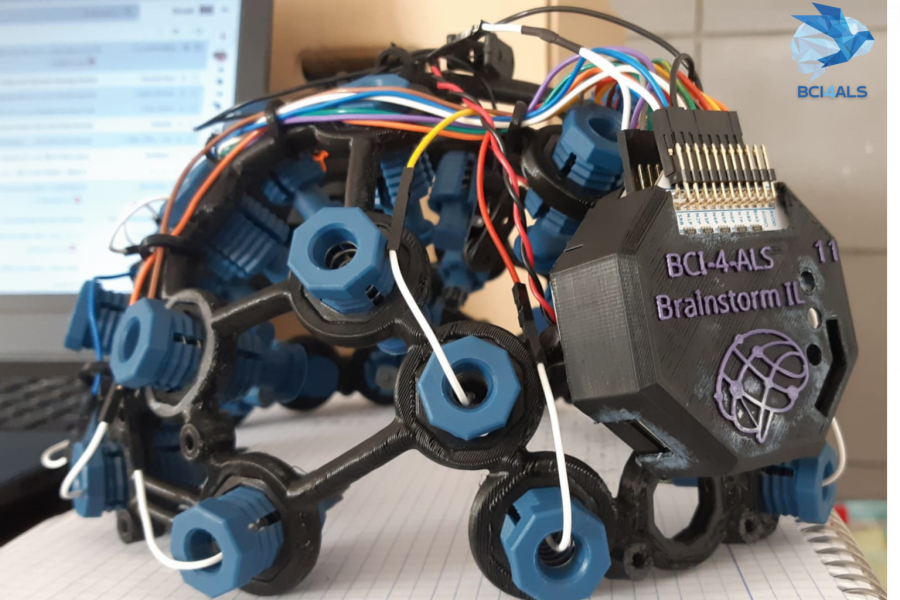
Introduction:
BCI maps brain signals into commands for external computer application. This is done by using machine
learning to train a classifier to interpret the brain signals and classify them into classes. For example, left
and right-hand movement. In order to achieve practical usage of BCI, the classifier needs to match the
user’s brain activity and obtain good accuracy rates throughout time.
The non-stationarity of the brain signals and its instability makes it hard for the classifier; a classifier that
has been trained on today’s brain won’t likely be able to achieve good accuracy rates on the brain signals
of tomorrow.
Proposed Solution: Part 1
Our first proposed solution is composed of three steps:
● Offline: First, we will collect offline labelled data from few days. Each sample with 𝑑 features
extracted using feature extractor.
For each feature 𝐹𝑖
, we calculate the KL-divergence between each two days 𝐷𝐾𝐿(𝐹𝑖
𝑑𝑎𝑦1
||𝐹𝑖
𝑑𝑎𝑦2
):
if it’s higher than KL_threshold we keep it, otherwise we drop it.
After feature filtering using KL-Divergence we continue to the next step with 𝑘 ≪ 𝑑 features
● Pre-online: this step includes partial calibration of the classifier in each day.
Each morning we sample from the mentor few labelled samples. Applying bootstrapping to the new
data. By the assumption that the data distribution changes with small motion we can leverage from
the offline data, we add samples from the offline set that are bounded by radius R from the mean
of each class in the new data, and this will be the train set for the specific day which the classifier
will be trained on. The pre-online step can be interpreted as composing the train set out from old
and new data, in a weighted way, the distribution of the train set will be similar to the offline data
as much as the new data is similar to the offline data – this coincides with our demands/aim: if
there is no data shift we want the train set to be as much the same as the offline data – because we
have a lot of data there. But if there is drastic data shift – we won’t be using offline data because
it’s irrelevant and we would have to work with the new samples only.
Proposed Solution: Part 2
In our second solution we attack the problem in a deep-learning approach:
We use the Domain Adversarial Training Network by Y. Ganin et al
The offline step here is the same as in Part1: we have labelled data collected from a few days.
We look at days as domains– in each day we are sampling from different domain distribution
Our aim is to learn features that are domain independent. Inspired by the theory on domain adaptation
suggesting that, for effective domain transfer to be achieved, predictions must be made based on features
that cannot discriminate between the training and test domains. How is this accomplished?
We have few fully connected layers which represent the feature extractor, which is connected to a
classifier (another fully connected layer)
In addition to the classifier for label prediction – we add a domain classifier, which has to predict in which
domain the sample is drawn from, however, instead of passing the gradient of domain loss 𝜕𝐿𝑑
𝜕𝜃 to the
feature extractor – we pass −
𝜆𝜕𝐿𝑑
𝜕𝜃 , aiming to maximize the feature extractor domain loss function rather
than minimizing it, in the same time minimising the label loss function – in total to learn feature extractor
generalized for all domains (days) – independently from which day we are recording.
Results
*Naïve algorithm: learns once from offline data and doesn’t update itself (classifier doesn’t change)
*Optimal algorithm: updates itself by doing full calibration every day (without addressing non-stationarity