

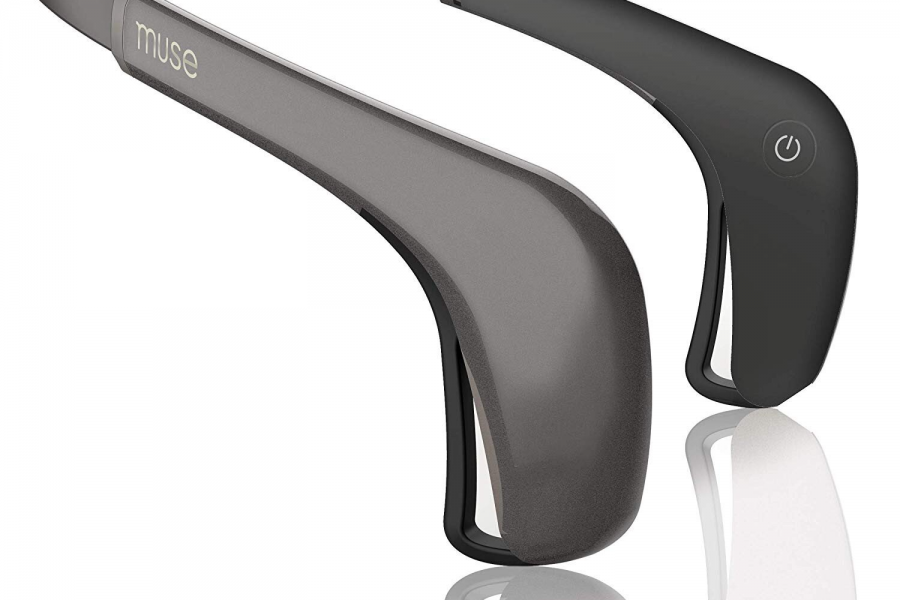
In this project we verify and implement the claim that horizontal eye movement can be classified through data received by the commercial EEG device – Muse headband. Furthermore, we attempt to check if there is a frequency limit on correct classification with the EEG device – Muse Headband.
To gather data from the muse, build the algorithm and test the accuracy of the algorithm a GUI application was implemented. That application merges and syncs two “data channels” the first is from the Muse headband and the second is the eye location. The eye location “data channel” is acquired from a dot moving on the screen from side to side, which the user follows while the Muse data is being recorded. The data is then synced and saved to a single csv file which can be analyzed offline.
From The data gathered The conclusion was that further research should be done in order to distinguish the eye signal from the noise.
After further research was conducted the idea for the algorithm was deduced, which is based on the anatomy of eye.
The eye consists of a lot of important components, but the focus is on specific two. The first is the cornea whose location is on the front of the eye, and accounts for approximately two-thirds of the eye optical power. The second component is the retina, which is a layer of light-sensitive tissue located at the back of the eye. These components are significant in these research because between them there is a small voltage difference. That voltage difference causes the eye to act as a magnetic dipole.
Since the muse has electrodes between the eyes and the ears, if we subtract the values if these electrodes we get a signal whose amplitude is doubled. These transformation outputs a signal which we could classify much more easily. To complete the algorithm we smooth the subtracted signal with a gaussian filter, subtracting it’s mean from it, in order to normalize the signal. Finally calculating the threshold based on the standard deviation in order to set the threshold based on the amount of noise in the signal.
The results were tested offline and online. Both showed good results but only if noise is avoided like muscle movement, and the eyes should move from one extreme side to the other.