

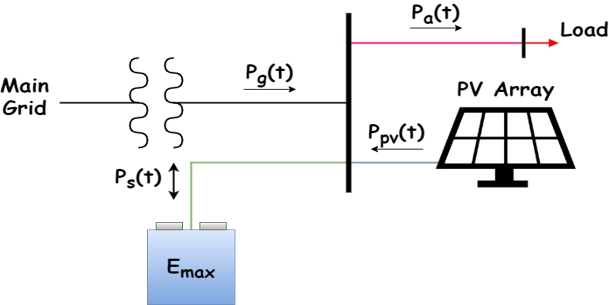
Energy storage describes a set of processes designed to convert energy and store it, in various forms, in a way that will allow it to be used later. Some of the energy storage methods are very common and constitute a significant part of the energy market, and for some an application to make them significant has yet to be found.
Over the past few years there has been an increase in the use of batteries and accumulators as a portable energy source for electric vehicles, and as a solution for storing excess energy produced by renewable energy sources. For these uses it is necessary to convert the constant DC voltage of the batteries to an AC voltage suitable for vehicles or the power grid. Since we want maximum efficiency and since the losses in these devices should not be ignored, there are continuous attempts over the years to develop solutions based on different methods and strategies of optimal control of energy storage systems. These methods can be divided into two main categories, classical methods and advanced methods, the classical methods include Linear programming, dynamic programming, stochastic control methods and Pontryagin’s minimum principle, and the advanced methods are further divided into metaheuristic techniques and machine learning techniques. So, each of the above optimization methods is suitable for different applications, and each application has its own theoretical and numerical challenges.
The solution of optimal power efficiency in accumulators in electric vehicle and power grid is obtained by the shortest path method which allows simple planning of the optimal generated energy and enables designers to estimate the required storage capacity for a specific application. Based on this method, several features of the optimal solution:
- When the capacity is very low, the generated power is approximately equal to the load power. In this case the storage device has little effect.
- When the capacity is high enough, the generated energy follows a straight line. The generated power is constant and is approximately equal to the average load. This result aligns well with common intuition.
- For medium capacity values, the optimal generated energy is the shortest path between the bounds the load energy and the capacity of the device.
We propose to calculate the shortest path based on Pontryagin’s minimum principle. This approach leads to a low-complexity algorithm for calculating the shortest path, since the only unknown variable is , and for each value of this variable the optimal solution may be calculated directly based on the following two differential equations:
Where is defined by
In addition, the proposed method is of theoretical interest since it is analytic and more direct, and therefore can be extended to other systems of interest, such as lossy networks, or networks with several storage devices operating in parallel.
The proposed algorithm for calculating the shortest path can be summarized as follows:
- Step 1. Perform a line search on : for each solve the differential equations and and obtain . Repeat until .
- Step 2. Compare the solution candidates obtained in the previous step and find the one with the lowest cost . This is the optimal solution .
- Step 3. Calculate the powers and using and the stored energy using .