

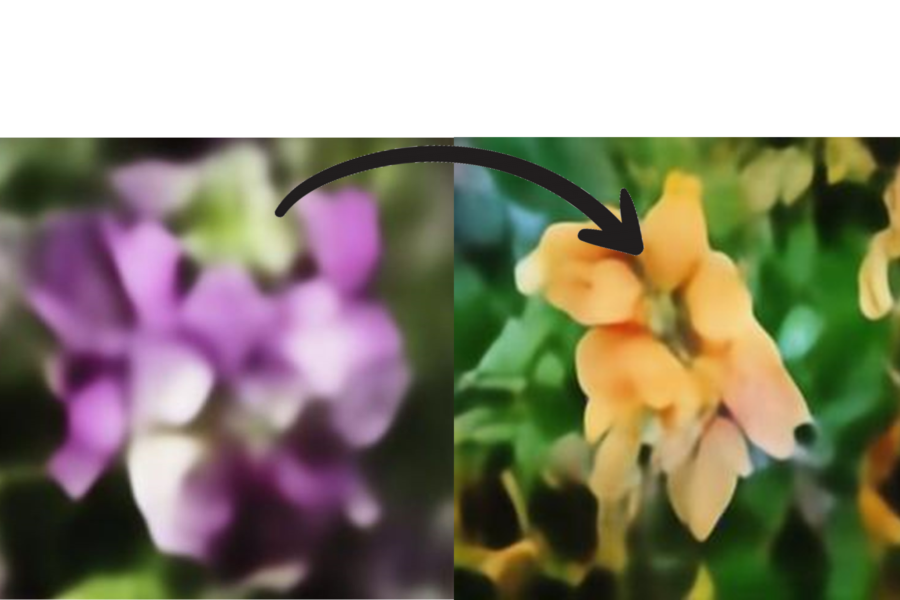
In recent years, there has been significant progress and interest in the research of generative models. These models learn the distribution of a particular input database and aim to use this distribution to generate new examples.
Typically, training a generative model requires a large input database that describes the input space. However, this poses a challenge as constructing such a database is a costly and time-consuming process that requires significant material resources and time to train the model.
To address this issue, we built a VAE-based model called projected VAE. This was achieved by using a pre-trained classification network to extract features from the image, which were then inputted into the model instead of the image itself. Each feature map undergoes projection and enters its own encoder. Then, all the encoders output is concatenated together so image reconstruction is performed by considering the contribution of all the encoders together.
This approach is based on an idea proposed in the article “Projected GANs converge faster,” where a model based on GAN was suggested to allow training on small datasets while achieving good results.
The goal of our project was to improve the results of the VAE model, particularly for small datasets. To evaluate the results, we trained and tested the model on various datasets of different sizes, using different parameters to find the best weights.
To verify whether the project’s goal was achieved, we compared the performance of our model to that of a regular VAE model with the same architecture, that we trained and tested to obtain the best weights for each dataset. The results of our model outperformed the regular VAE model in most cases, demonstrating the effectiveness of our approach.