

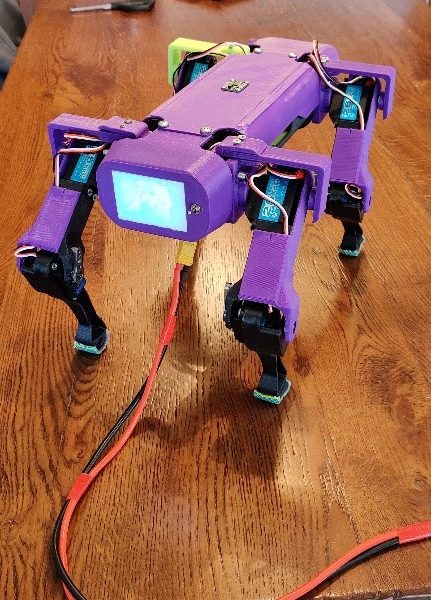
Charlie-Bot is a 3d printed, low cost, quadruped robot. Charlie bot is dedicated to our beloved dog Charlie. His physical structure is based on Boston Dynamics’s spot and the original 3d .stl files were made by Deok-Yeon Kim. The Charlie-Bot project required designing and engineering in multiple areas including the physical structure, the hardware and electrical systems, the software, and how to integrate them all together.
Charlie-Bot was originally an undergrad project made by shai Schnarch and Julia Laikhtman, and supervised by Kobi Kohai. After the original project, Shai Schnarch and Eden Eluashvili continued the project under the guidance of Kobi Kohai. The state of the Charlie-Bot project when Shai and Eden began was that the basic infrastructure and robot was built, most of the hardware was integrated and tested, and Charlie-Bot could perform simple tasks like walking while suspended in the air (could not walk on the floor). Furthermore, Charlie-Bot had no external sensors, and needed improvements to the physical structure as well as the software.
When we (Shai and Eden) started working on Charlie-Bot we had a few goals. We wanted to make him move and walk on the floor, make him more doglike, integrate new sensors, and improve the overall infrastructure for better and faster future improvements. To do so, we firstly upgraded the physical structure by lengthening Charlie-Bot’s body and strengthening a bad shoulder design. We than added an IMU sensor that allowed Charlie-Bot to know his orientation in real time. Lastly, we made huge improvements to the software by switching over to an object-oriented design and smartly integrating the IMU.
Now that we finished upgrading Charlie-Bot, we got started on actually implementing movements and dog-like abilities. In total we developed 6 different movement modes ranging from walking to dog-like abilities such as sit, shake tail and dance. Some of the more challenging moves were achieved with the help of the IMU for real-time feedback and corrections which allowed Charlie-Bot to be more stable and not fall to one side. A video showcasing all of these moves and the finished Charlie-Bot can be found here.
In conclusion, during our project we identified shortcomings in the original Charlie-Bot, found ways to overcome them, implemented useful working moves, and made a fully working low cost 3d printed quadruped robot with a lot of abilities named Charlie-Bot.