

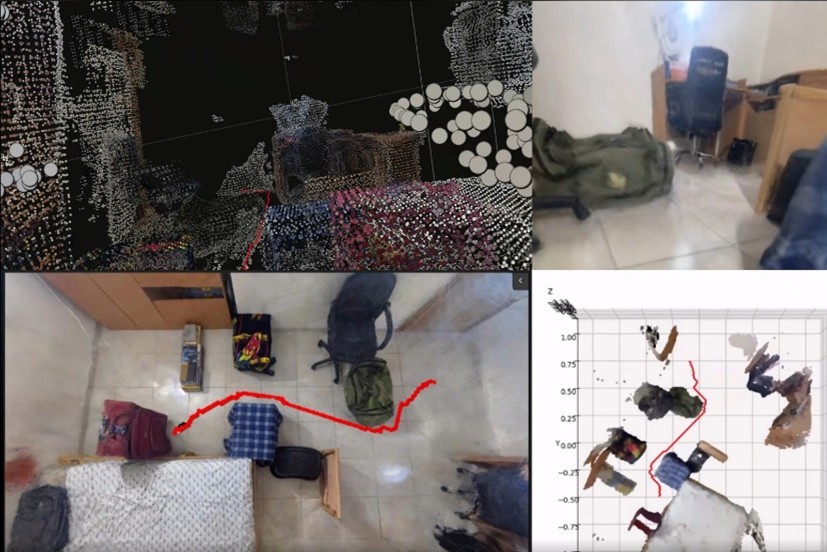
surroundings has driven major advancements in 3D scene reconstruction. One of the most promising approaches in recent years is the use of Neural Radiance Fields (NeRF) -a method that generates photorealistic 3D representations of environments based solely on 2D images. This project focuses on utilizing NeRF techniques to reconstruct indoor environments and plan robotic navigation paths within them.
The project leverages the NeRFstudio platform, which serves as a comprehensive framework for NeRF training, optimization, and visualization. Within this environment, two leading NeRF-based architectures were implemented: Zip-NeRF, known for its memory efficiency and high-quality rendering, and Nerfacto, which balances speed and fidelity by combining implicit representations with sparse features. These techniques enable the generation of rich 3D models that accurately capture geometry, textures, and lighting conditions—even in complex, cluttered scenes.
Once the 3D model is generated, it is processed to support robotic path planning. The virtual environment is analyzed to identify obstacles, free space, and navigable routes. Based on this data, the system computes efficient and safe pathes that a robot can follow in order to move through the space while avoiding collisions and optimizing distance or other constraints. This stage integrates spatial reasoning with real-world geometry, simulating how a robot would perceive and respond to its surroundings.
The integration of NeRF-based reconstruction with path planning demonstrates a powerful tool chain for autonomous systems operating in unfamiliar or dynamically changing environments. Applications of this approach are broad and include indoor robotics, autonomous navigation in GPS-denied environments, simulation for robotics training, and emergency response planning. Additionally, this workflow reduces the need for manual mapping or expensive 3D scanning hardware, offering a scalable and flexible solution.
Overall, the project highlights the synergy between modern vision-based modeling techniques and traditional robotics tasks, showcasing the potential of NeRF technologies in the next generation of autonomous intelligent systems.