

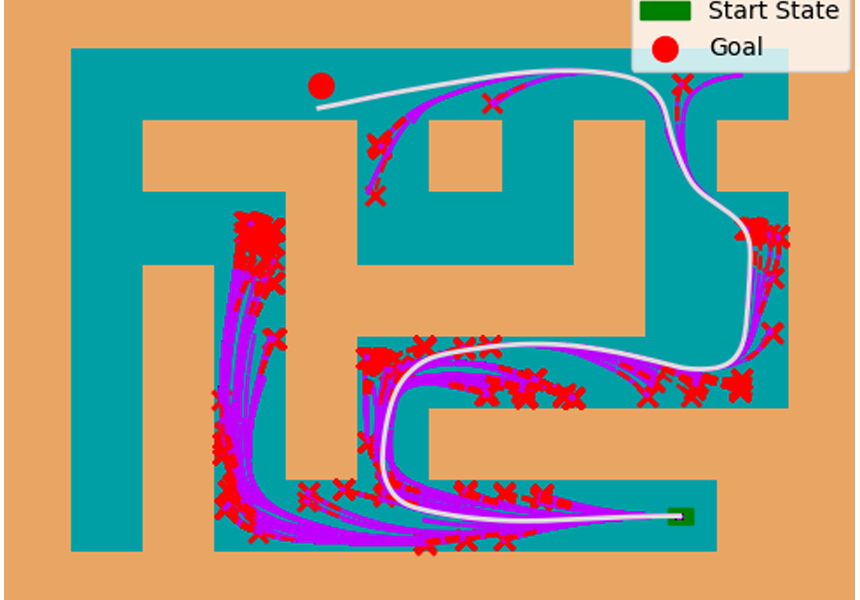
Kinodynamic motion planning is the problem of finding a collision-free path for a robot while considering its physical constraints. This could be especially challenging in complex environments. The classic approach to this problem is RRT (Rapidly-Exploring Random Trees) but it could be random and inefficient.
Learning-based approaches such as diffusion models provide goal-directed and data-driven sampling, however they may not perform well in new and unfamiliar environments. DiTree combines both approaches by using diffusion models to plan the expansion of a tree. This allows both the reliability of RRT and the more guided exploration of learning-based approaches.
In this project, our aim is to improve the performance of the DiTree algorithm, focusing on key evaluation metrics by introducing several new features such as tree pruning and batch parallelization. We first tested each feature separately and then evaluated selected combinations to study their interactions.
Our results show that structural and light model optimizations provide the most consistent improvements. In particular, tree pruning and quantization improved both runtime and success rate across many scenarios. Overall, the results highlight that reducing unnecessary computation is more effective than increasing exploration, and that combining complementary techniques is key to achieving better performance.