

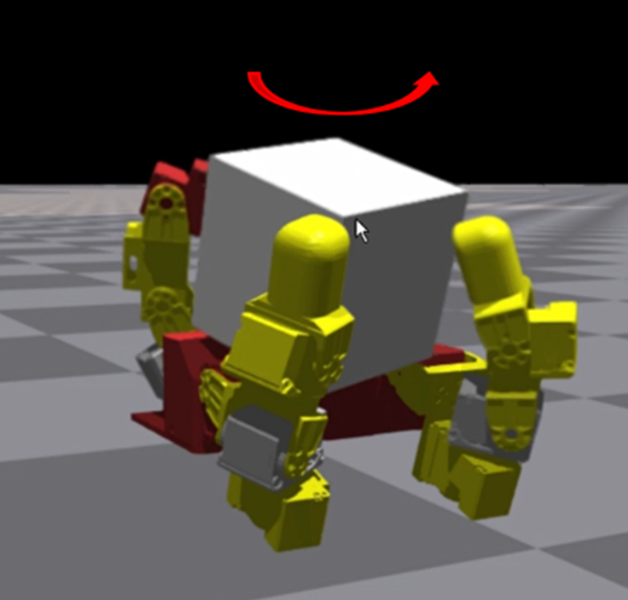
Our project aims to create a leap hand simulation with three fingers to rotate a cube. Initially designed for a model with four fingers, we are adapting it to be compatible with three fingers. The core objective is to train the model to rotate the cube successfully without failure. This project is fundamentally rooted in reinforcement learning (RL), where we have an agent interacting with an environment.
In our setup, the agent represents the simulated hand with three fingers, and the environment is the virtual space where the cube resides. Through iterative experiences, we aim to identify the optimal configuration by systematically removing one finger at a time from the original four-fingered model.
By conducting experiments with different finger configurations, we seek to determine which combination yields the best results in terms of successfully rotating the cube without errors. This process involves training the RL agent to adapt to the new finger setup and learn effective strategies for manipulating the cube.
Overall, our project leverages RL principles to explore and optimize the interaction between the hand simulation and the cube environment, ultimately refining the model to achieve seamless rotation with the three-fingered configuration.