

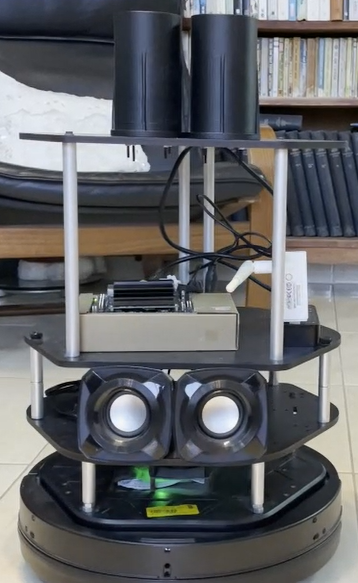
In recent years there has been significant technological progress in the world of robotics. The need to use robots in operations performed so far by humans has intensified and particularly in tasks that include autonomous navigation of robots, such as bomb disposal or locating missing persons.
This project is about the autonomous navigation task. The main goal of the project is to make a Turtlebot2 robot successfully navigate autonomously towards a target pre-defined by an operator while carrying objects from place to place.
The work during the project was done on a Jetson Nano controller. This controller is a computer that manages the activity of the robot, receives continuous real-time information from the sensors about the environment, and gives movement instructions to the robot base. The robot navigates using various sensors, including the Lidar sensor, a laser-based sensor designed to determine distance, and motion sensors that provide audiometry data to estimate the direction of the robot. The work was done in a ROS environment, which is a software environment designed for robots.
In order to achieve the goal of the project, a preliminary mapping process of the area was first performed using the Hector SLAM algorithm when at the end, a map of the scanned space was obtained which was saved using a Map-server package.
Later, for the navigation process itself, ROS navigation stack was used and in particular, the amcl algorithm that is responsible for the localization of the robot in two dimensions, the navfn_global_planner algorithm that is responsible for optimal path planning, and the dwa_local_planner algorithm that controls the creation of movement commands for the robot according to the progress of the route and the environment.
To increase the number of successful navigation attempts, adjustments were made to several parameters to improve the navigation algorithm. The results of the project showed that the vast majority of navigation tasks were carried out successfully while driving smoothly, planning an optimal route, and avoiding obstacles.
The task of the project was also achieved by successfully navigating the robot to the destination to collect the beer bottles and then another order set the target destination, to which he successfully navigated for the purpose of transporting the beers to their destination.